Philodendron gloriosum Variegated Type 1
Philodendron gloriosum
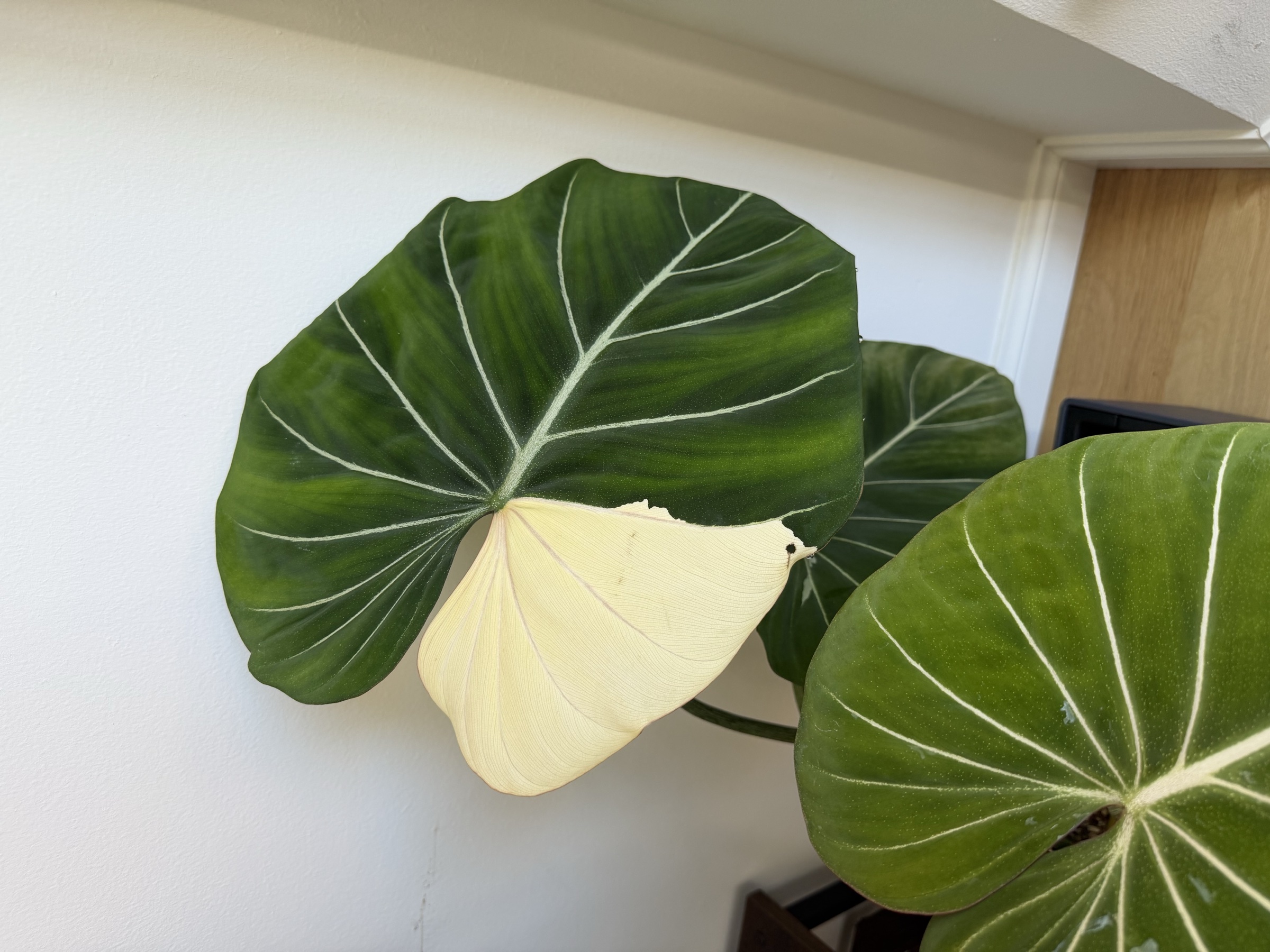
Variegated Philodendron gloriosum is an ultra-rare terrestrial creeper with heart-shaped velvet leaves featuring cream-white sectoral variegation. Type 1 (block) costs $600–$2,500+; Type 2 (splash) runs $300–$800. Requires 60%+ humidity, bright indirect light, and horizontal planter space. Difficulty: advanced. Toxic to pets.
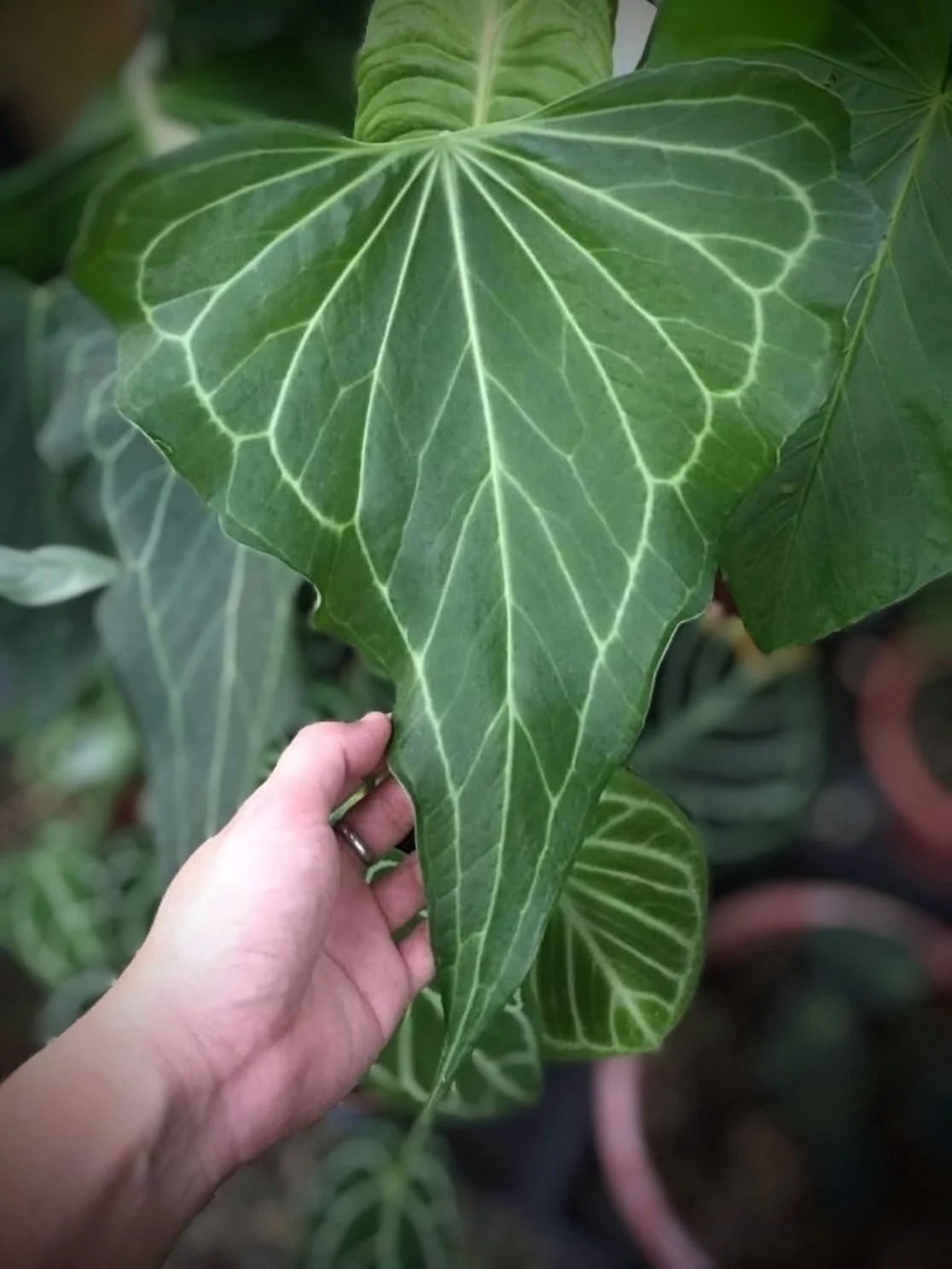
A terrestrial creeper with heart-shaped leaves of deep emerald velvet, interrupted by strokes of cream and white variegation. Each leaf is a living canvas — no two patterns alike.
Last reviewed: March 2026
At a Glance
- Price range
- $300-$2,500 — Size & variegation dependent
- Leaf cycle
- ~1 per month (ideal) — Often 2-5 leaves/year in home conditions
- Difficulty
- Advanced — Consistency non-negotiable
- Humidity
- 60%+ (higher is better) — More humidity generally improves performance
- Space
- Wide, not tall — Terrestrial creeper
- Annual growth
- ~1 ft/year — Varies by setup and consistency
Care Requirements
- Light
- Bright indirect — East or north-facing. Variegated tissue burns even in brief direct sun — irreversible browning on white sectors.
- Humidity
- 60%+ — More humidity is generally better. Below ~50%, leaves often emerge smaller and less velvety. Misting is usually insufficient — use a humidifier.
- Temperature
- 65–85°F — Stable warmth matters more than exact numbers. Below 60°F, growth stalls. Cold window drafts in winter are a common killer.
- Watering
- Let dry 2″ first — The rhizome rots if kept constantly wet. Water thoroughly when you do, with complete drainage. Reduce by ~40% in winter.
- Feeding
- Every 1-2 weeks — Feed consistently during active growth. Reliable nutrition supports faster leaf production and stronger foliage.
- Repotting
- About yearly — With roughly a foot of annual crawl, a yearly repot/upsize is common to keep the plant stable and properly hydrated.
- Difficulty
- Advanced — Humidity and consistency are non-negotiable. This is not a plant for casual or intermittent care.
- New growth
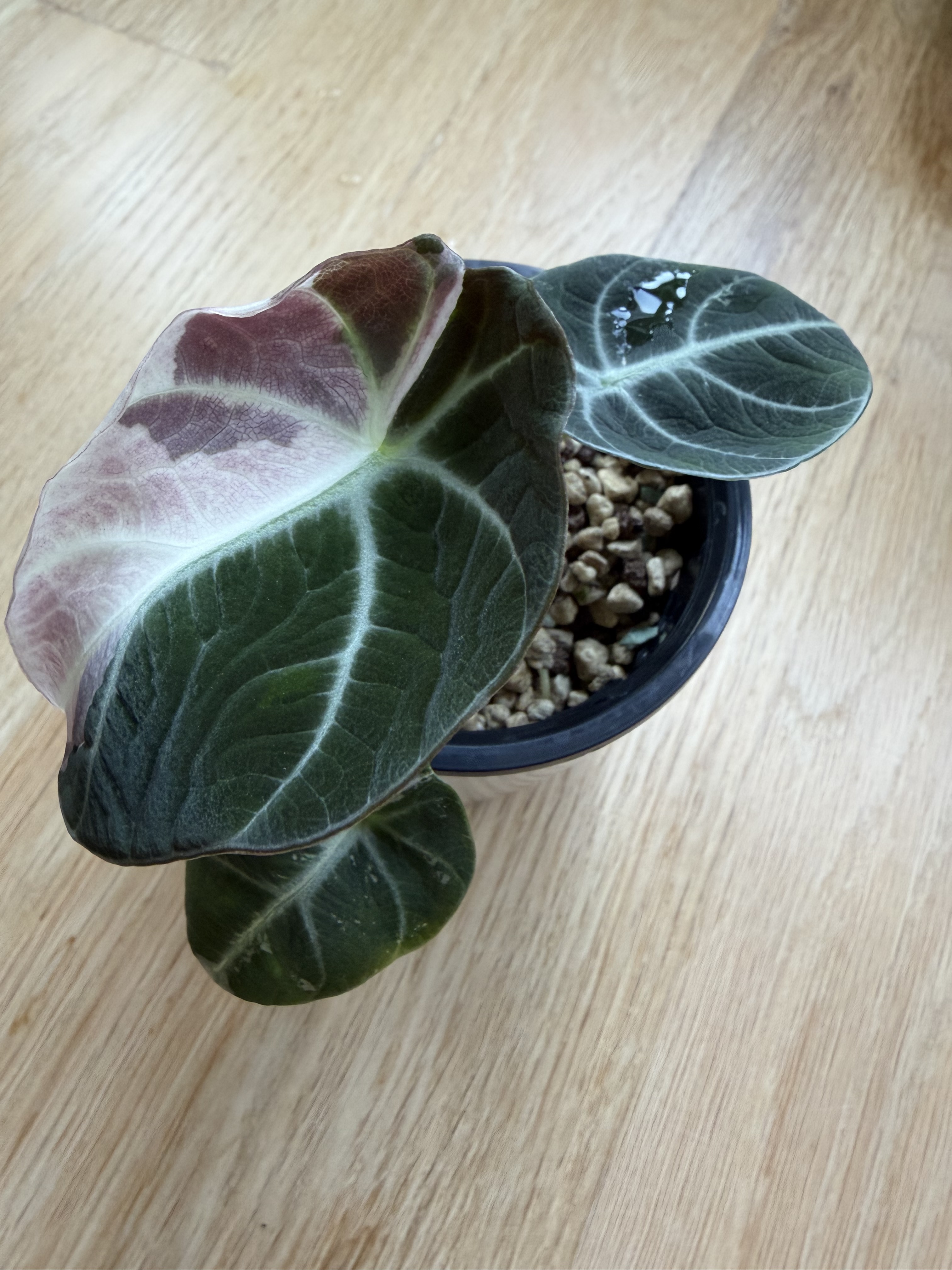
- Pinkish-red emergence — New leaves emerge pinkish-red and harden to deep green — normal and not a sign of stress.
Type 1 vs Type 2
Not all Gloriosum variegation is equal. Two distinct forms exist, and they differ in origin, stability, tissue culture status, and price. Think of it like Monstera albo versus Thai Constellation — same species, fundamentally different variegation.
Type 1 — Block Variegation
- Color
- #85b98e
- Pattern
- Large, defined blocks of color that emerge yellow on new leaves and harden off to a creamy white. Clean, dramatic sectors — half-moons, quarter-sectors, and full-coverage leaves are all possible. The variegation is clearly visible in the stem and rhizome as yellow-green striping.
- Stability
- Unstable. Can produce several fully green leaves before throwing another variegated one. However, the stem and rhizome tend to hold variegation extremely well — even when leaves come out green, the growing point typically retains the mutation and will produce variegated leaves over time.
- Market
- Significantly more expensive. Not yet in tissue culture. The original plant was purchased by plant influencer Kaylee Ellen and has since been distributed to NSE Tropicals and a handful of other sellers. Supply is extremely limited.
This is the collector’s form. Each unfurl is a genuine gamble — the variegation is not guaranteed on any given leaf, but the rhizome’s commitment to the mutation means patience is usually rewarded.
Type 2 — Splash Variegation
- Color
- #cdab79
- Pattern
- Fine flecks, speckles, and irregular splashes of white, light green, and yellow scattered across the leaf surface. Less dramatic contrast than Type 1 — the effect reads as texture and shimmer rather than bold graphic pattern.
- Stability
- Very stable. The splash pattern persists reliably across new growth with minimal risk of reversion. Comparable to Thai Constellation’s consistency.
- Market
- Widely tissue cultured and significantly more accessible. Pricing reflects the higher supply — far less expensive than Type 1, making it a more practical entry point for collectors who want variegated Gloriosum.
A noisier, busier aesthetic compared to the clean elegance of Type 1. Beautiful in its own right, but a fundamentally different visual experience. Some growers prefer the subtlety and reliability.
Type 1 is rarer, more dramatic, and less predictable. Type 2 is stable, accessible, and widely available. Neither is objectively better — but they are different plants in practice. Know which you’re buying.
Substrate
Gloriosum is best in a dense, anchoring substrate rather than straight LECA. As roots and foliage gain weight, the medium needs to physically support the plant while keeping moisture consistent.
Lechuza Pon + Self-Watering Planter (Recommended)
A stable mineral option that supports fine roots and stays structurally consistent. Self-watering planters can work very well when configured correctly.
Excellent if you commit fully. Expect a 2–4 week adjustment period from soil.
Choose a planter with enough horizontal room and water capacity as the plant matures and gains weight.
Provenance
Philodendron gloriosum is native to Colombia, carpeting humid lowland and premontane forests from sea level to ~1,500m. First formally described in 1876 by Édouard André — variegated forms didn’t enter serious collector markets until tissue culture made them more available in the 2010s. Philodendron gloriosum is listed as Vulnerable on the IUCN Red List of Threatened Species.
- 1876
- Édouard André formally describes Philodendron gloriosum from Colombian specimens, published in L'Illustration Horticole, volume 23, page 194.
- Conservation status
- Philodendron gloriosum is listed as Vulnerable on the IUCN Red List of Threatened Species. As of 2021, only approximately 7 locations worldwide have confirmed wild populations, all in Colombia. The cultivated collector market operates entirely on propagated stock — wild collection is not the source of traded plants.
- 1970s–80s
- Green-form enters European trade via Dutch nurseries. Niche collector’s plant.
- 2010s
- Type 2 (splash) variegated forms appear via Southeast Asian tissue culture. Type 1 (block) variegation surfaces through private collectors.
- 2020–Now
- Global demand drives prices. Type 1 specimens — traceable to Kaylee Ellen’s original — command $1,000–$2,500+. Type 2 is more widely available at $300–$800.
Propagation
Rhizome Sectioning
- Method
- Rhizome Sectioning
- Timing
- Spring or early summer
- Success Rate
- High
- Difficulty
- Moderate
The creeping rhizome can be divided at nodes, giving each section a viable growth point and root system. This is the only practical home propagation method for gloriosum.
- Identify the nodes: Nodes are visible as white strips along the stem/rhizome. Each node is a potential new growth point.
- Cut between nodes: Cut cleanly between nodes with a sterilized blade. Avoid crushing or sawing through tissue.
- Preserve roots on each division: Keep at least one viable growth point and healthy roots on each division.
- Treat cut surfaces: Treat cut surfaces with cinnamon or sulfur powder as antifungal.
- High-humidity recovery: Keep humidity above 70% and avoid direct light for 2–3 weeks post-division.
- Light watering only: Light moisture only until new growth resumes — do not saturate.
Warnings
- The stem can show yellow-and-green variegation; expression is unstable and leaf output can alternate between green and variegated.
- Even sections that look mostly green can still throw variegated growth later.
- Overwatering fresh divisions is the primary cause of post-division rot.
Frequently Asked Questions
Pricing & Value
- How much does a variegated Philodendron gloriosum cost?
- Type 1 variegated gloriosum typically ranges from $600–$2,500+, reflecting its unstable variegation, limited supply from the original Kaylee Ellen lineage, and absence from tissue culture. Smaller or less-variegated specimens occasionally appear at the lower end of this range. Type 2 variegated gloriosum is more affordable, especially in tissue culture form, where specimens go for $100–$300. Regular, non-variegated gloriosum costs $20–$30 by comparison.
- Is variegated gloriosum worth the price?
- Not if you're attempting to flip the plant for profit. The propagation timeline is extremely long, and the variegation is unstable — often requiring multiple green leaves before producing a consistently well-variegated leaf. However, if you're collecting for personal enjoyment, the rarity justifies the investment for many collectors.
Variegation Types & Classification
- What is the difference between Type 1 and Type 2 variegation on Philodendron gloriosum?
- Type 1 features block variegation similar to Monstera albo, with rich white sections that appear in distinct patches. Type 2, often called splash variegation, displays a softer, more diffuse marbled pattern. Type 1 is less stable and more prone to reverting.
- What does albo variegated mean for gloriosum?
- Albo variegated typically refers to Type 1 variegation — the block variegation style. This is distinctly different from Type 2 splash variegation.
- Is gloriosum variegation stable, or will it revert?
- Variegation in gloriosum is naturally unstable. Even a fully green stem can throw variegated leaves if variegation exists elsewhere in the stem structure, since stems can grow over an inch in diameter and carry hidden variegation. Reversion to solid green is part of the plant's natural pattern.
Propagation Timeline
- How long does it take to propagate a variegated gloriosum?
- From cutting a node to obtaining one or two consistently variegated leaves, expect four to six months. This lengthy timeline makes the plant unsuitable for quick resale.
- How do you identify nodes on Philodendron gloriosum?
- Nodes are extremely visible and appear as small white bumps or sections that protrude from the stem, distinctly colored from the rest of the stem material. They're easy to spot once you know what to look for.
- Can a green-stemmed gloriosum throw variegated leaves?
- Yes — if variegation exists elsewhere in the stem. Since stems can reach over one inch in diameter, variegation may be present internally even if it's not visually apparent on the surface.
- Is gloriosum worth buying for propagation and resale?
- Only if you acquire it at a reasonable price. Unless Type 1 enters tissue culture production, prices are unlikely to drop significantly below $300, making profitable resale difficult to achieve.
Care for Variegated Forms
- Does variegated gloriosum need more light than the standard form?
- Yes — variegated specimens generally need more light to maintain their patterns. However, be cautious with direct light, as it can burn the leaves. Bright, indirect light with added warmth is ideal.
- What substrate works best for variegated gloriosum?
- Lechuza Pon is the best option. It provides consistent humidity, excellent stability, and is particularly suited to the plant's thin root system.
- Why are my gloriosum's variegated leaves reverting to green?
- This is the natural pattern of the plant. If reversion becomes problematic, you can attempt propagation and select nodes from clearly variegated portions of the stem.
Buying Guidance
- Where should I buy variegated Philodendron gloriosum?
- In the United States, NSE Tropicals is your best source — they maintain the original plant lineage from Kaylee Ellen. In the UK, purchasing directly from Kaylee Ellen is recommended. Pay close attention to plant lineage and verify you're not accidentally buying tissue-cultured Type 2 when seeking Type 1.
- Tissue culture versus rooted cuttings — which should I buy for variegated gloriosum?
- Type 1 has not yet appeared in tissue culture, so rooted cuttings are your only option and are generally superior anyway. When purchasing, look for plants that have already pushed out one to two variegated leaves, as this demonstrates stability. The plant can revert easily, so past performance is a helpful indicator.
Safety
- Is Philodendron gloriosum toxic to pets or humans?
- Yes. Like all Philodendrons, gloriosum contains calcium oxalate crystals throughout its tissue. Ingestion causes oral irritation, excessive drooling, swelling, and gastrointestinal distress in cats, dogs, and humans. Keep the plant out of reach of children and animals, and wear gloves when handling damaged tissue.
Downsides
Slow growth is really slow
4–8 weeks per leaf means 6–8 leaves per year in ideal conditions. Most homes aren’t ideal. It will not fill a space quickly.
Variegation is a gamble (especially Type 1)
Type 1 block variegation is unstable — green leaves happen. Type 2 splash is more reliable, but neither guarantees the leaf you want every time.
The horizontal footprint
As a creeper it sprawls sideways. That wide, shallow planter takes real surface area a climbing plant wouldn’t.
Price makes mistakes expensive
At $300–$2,500+, a watering error, cold draft, or pest outbreak carries real financial weight.
Pest vulnerability
Velvety foliage is highly attractive to spider mites and similar pests. Preventive monitoring and treatment are part of normal care. Growing in semi-hydro (leca or pon) can help reduce risks.
Toxic to pets and children
Calcium oxalate crystals throughout all tissue — ingestion causes oral pain and GI distress in cats, dogs, and humans. Not a shelf plant in households with curious pets or young children.
Not a quick chop-and-prop flip
From cutting a node to rooted, verified resale-ready growth is often 6+ months: around 2 months to push new growth, 3-4 months to root after chopping, then extra time to verify stability.
Toxicity
Toxic to cats, dogs, and humans. Contains calcium oxalate crystals throughout all plant tissue.
Toxic compounds: calcium oxalate crystals.
Symptoms if ingested: oral irritation, excessive drooling, swelling, gastrointestinal distress.
Common Mistakes
- Using a tall pot instead of a wide, shallow planter — gloriosum is a terrestrial creeper that grows horizontally, not vertically.
- Expecting every leaf to be variegated — Type 1 variegation is unstable and can produce several green leaves between variegated ones.
- Overwatering the rhizome — the creeping stem rots quickly in waterlogged conditions.
- Buying unverified Type 1 when it's actually Type 2 splash — always confirm the variegation type before purchasing at Type 1 prices.
- Cutting rhizome sections too small — each division needs at least one node with healthy roots to survive.
Price History
Type 2 (splash) variegated gloriosum has dropped roughly 50% since 2022 as tissue culture production expanded — specimens that were $600–$800 now trade at $300–$500. Type 1 (block) remains expensive at $600–$2,500+ because it has not entered tissue culture. The original Type 1 lineage traces to Kaylee Ellen's plant, distributed through NSE Tropicals. Until TC becomes available for Type 1, prices are unlikely to compress significantly.
Tissue Culture
Type 2 (splash) variegation is widely tissue cultured and available at accessible prices. Type 1 (block) variegation has NOT entered tissue culture — all specimens are cutting-propagated from the original Kaylee Ellen lineage. This distinction is the primary driver of the price gap between the two forms. Wild-collected gloriosum exists but is legally restricted under Colombian export law; the variegated forms are exclusively cultivated mutations.
Availability
Type 2 (splash) is available year-round from TC suppliers. Type 1 (block) is extremely limited — typically only available from NSE Tropicals (US) or directly from Kaylee Ellen (UK). Expect waitlists. New cuttings tend to appear in spring/summer when growers divide actively growing rhizomes.
Verdict
A slow, demanding, extraordinarily beautiful plant that rewards patience and punishes neglect. Not a casual purchase.
Related Plants
References
- NSE Tropicals — Primary US distributor of Type 1 — Specialist nursery that holds original Type 1 variegated gloriosum stock from the Kaylee Ellen lineage.
- Kew Plants of the World Online — Philodendron gloriosum — Taxonomic reference and distribution data for the species.
- ASPCA Toxic Plant Database — Philodendron — Toxicity information for pets regarding Philodendron species.
- IUCN Red List — Philodendron gloriosum — Conservation status assessment listing gloriosum as Vulnerable.